Shoe-throwing may now be mostly a political act. But not long ago, it was a common rite of marriage, writes James Crombie of Aberdeen, who has gathered some matrimonial footwear-hurling facts into a 24-page treatise called Shoe-Throwing at Weddings.
This was in 1895, when readers may have empathised with Crombie’s opening thought: “Pelting a bride and bridegroom with old shoes when they start on their honeymoon is a custom we are all familiar with, and in which many of us have participated.”
Some 113 years later, in 2008, Muntazer al-Zaidi recategorised the social role of shoe-throwing when he hurled size-10 shoes, and some words (“This is your farewell kiss, you dog”), at US president George W Bush at a press conference in Baghdad.
Crombie’s article is pretty apolitical, and makes no bows to podiatrical correctness. Though his paper was published in the journal Folklore, Crombie was no worshipper of footloose or flighty tales. He helped establish the first seismological observatory in the Aberdeen area and was a generous donor to Oxford Observatory.
Crombie writes that around the world lots of people make a practice of throwing something at newlyweds. Rice, especially, has had wide popularity.
Victorians put their best foot forward in the choice of missile, Crombie writes: “For whereas we find the custom of throwing rice, or some other cereal, prevalent in almost every land, we find shoe-throwing practised mainly, I think, in those parts of the world inhabited by Englishmen or directly influenced by them, among the wandering Gypsies of Transylvania, some parts of India, and one or two other places.”
Nuptial bombardment is meant to induce luck, he says. Sometimes it summons more than luck. Crombie points to the large Indonesian island of Celebes (now called Sulawesi). “At South Celebes,” he writes, “rice is thrown on the head of anyone in whose honour a festival is held, with the object of detaining the soul, which at such times is in especial danger of being lured away by envious demons.”
Shoes, he writes, are sometimes essential wedding elements even when hand-delivered rather than heaved – especially in Germany and Finland. “According to a sumptuary law of Hamburg, enacted in 1291, the bridegroom was bound to present the bride with a pair. They almost played the part of our engagement ring and were, as it were, evidence of betrothal.”
And in his own era, in east Finland, Crombie says, a mother-in-law would not permit her new son-in-law to bed his bride until the young man had presented the mother-in-law with a pair of shoes.
Shoes, he tells us, can also be essential, symbolically, at the end of a marriage. “A Bedouin form of divorce,” Crombie reports, is, “she is my slipper, I have cast her off.”
Tuesday, September 22, 2015
Monday, September 7, 2015
Picture perfect: how to make it as a wedding photographer
![]() |
| Experiment with interesting angles and risky compositions, says wedding photographer Steven Rooney. Photograph: Steven Rooney |
The early 21st century wedding photographer bears little resemblance to this old caricature. Today they work within a fast-growing, highly competitive, dynamic industry, straining to portray the wedding day in their own unique style. Some work like photojournalists, gliding invisibly between the guests, looking for candid moments. Others choreograph scenes with all the sophistication of film directors, capturing shimmering dresses, leaping groomsmen or epic backdrops.
Meanwhile, the barrier to entry remains low. Anyone with a camera can set themselves up as a wedding photographer and pitch to one of the quarter of a million couples getting married in England and Wales each year, part of an industry across the whole UK that is worth an estimated £10bn. The lure of the money, the freedom of the job and the scope for turning a hobby into a business ensures that the sector is a competitive one. So what does it take to succeed?
Steven Rooney, a wedding photographer from Southport, has watched the evolution of the profession. As a boy, he learned his craft from his grandfather, a teacher who used to photograph weddings in his spare time. Those times with his grandfather’s Canon AE1 camera and Ilford black and white film were the genesis of Rooney’s career. Though originally trained as a teacher, he kept up his photography and one day a friend asked him to shoot his wedding. It was the stepping stone into a career that has seen him become one of the north-west’s leading wedding photographers.
The support of his friends and family has been key to Rooney’s success. His brother designed his first website, a friend who worked for an accounting firm helped him to set up as a limited company and then his wife, Sally, joined him. She takes care of the admin for what is now a family business. “She holds our business together,” Rooney says. “She’s much more organised than me, she also designs the albums, runs the house and looks after the kids while I’m shooting weddings.”
Rooney’s business expanded slowly. It was a gradual slide into weddings rather than a sudden move from teaching. For Rooney this was important as he could build his portfolio steadily, picking the assignments that interested him. “I followed American photographers like Jeff Newsom and began to develop a client base of people who liked my style. There are lots of different techniques: double exposures, long exposures, pictures of stars, painting with light.”
Business is also going from strength to strength for Ann-Kathrin Koch, a Birmingham-based, German wedding photographer. Koch has a reputation for beautiful documentary shots, a style of visual storytelling that she puts down to her training as a freelance film editor.
Like Rooney, Koch built her business gradually. “I was able to do both the film editing and the wedding photography for quite a long time,” she says. “I had started out with photography in my early 20s, using websites like Flickr. The community back then was all about Flickr and I would take pictures of everything around me and post them. It also got me interested in how others did what they did.”
Social media was not just a training ground for Koch, but also a source of clients during her first year as a wedding photographer in 2011. She says: “I did a handful of weddings that year – friends and connections through Flickr. I then started to blog about everything I was doing – mostly it was about photography, but it was not exclusively about weddings.”
In 2012, she went full-time and shot 26 weddings. Since then the numbers have continued to rise; Koch sets herself apart by using a Hasselblad H2 film camera and medium format film, and benefits from an growing digital profile and word of mouth recommendations. Last year, she travelled 33,531 miles through 13 different countries.
It is intensive work. Katrina Otter, a wedding and event planner, points out that there is so much more involved for photographers than before. “They are really involved in the planning process. Often they meet me or the couples beforehand to plan how they’re going to tell the story of the day. Then they have to work in different environments and adapt quickly to changes in conditions – the light or the weather.”
Both Rooney and Koch acknowledge the importance of making this connection with the couples prior to the wedding. It’s part of the hidden work a wedding photographer does. Rooney explains, “When someone enquires, I speak to them about the wedding. I think this is very important. We meet up at their house or we find a cafe. More often than not we get on, and we talk about the day.”
But, Rooney explains, that is just the first part of the process. He adds: “People often say, ‘This is a nice job, what do you do for the rest of the week?’ They don’t realise that afterwards you go home, back up the cards, back up the backup and render the files, chose which to edit, then spend about 10 hours editing before uploading them into a gallery or a slideshow and getting back to the couple.”
It’s a workload that aspiring wedding photographers might underestimate, and it’s also one of great responsibility. Rooney admits to taking a backup of his photographs on holiday for the sheer terror of losing them. Another common pitfall is being asked by friends to work for free. Koch cautions against this: “The most important thing to remember is that it’s a business you’re running, and not a hobby anymore. If you are running it as a hobby you’ll always lose out in the end. It’s not a sustainable business that way.”
Far from being an added-extra, for Otter, the wedding photographer is an essential part of the day: “On my planning list it is pretty much top of the list after the venue. I have so many friends who have decided to save on their photographer so they can put more towards the dress, the alcohol or the food and they really regretted it afterwards. You will always notice your wedding photos, much more than you’ll look back at your shoes.”
![]() |
| Ann-Kathrin Koch trained as a film editor Photograph: Ann-Kathrin Koch |
1) Practice - a lot. Take your camera everywhere with you until you know it inside and out and can use the dials and buttons without looking.
2) Always have backups and spares. Spare cameras and lenses, disc drives and backups of your work. When you pay the bills with your camera you can’t risk anything going wrong.
3) Charge what you’re worth and work out what your income and outgoings are to be to make sure you’re earning what you should. A good accountant can really help with this.
4) Try, fail and improve. In order to be unique and stay creative try different things, interesting angles and risky compositions. Be yourself and develop your own style.
5) Keep in touch with other photographers. It can be a lonely job sometimes but there are some great photographers who are happy to help you along the way, from social media groups to official organisations, networks and training courses.
Sunday, August 23, 2015
The Skype ceremony – the young Tajiks getting married online
![]() |
| A Tajik bride on her wedding day. Couples say Skype is an increasingly convenient way to take their vows. Photograph: Ksenia Diodorova |
Her groom, however, is a continent away from the ceremony working as a translator in Tunisia. Just moments before the photo was taken, the couple had exchanged their vows via an online video chat service.
Idrisova’s husband is one of hundreds of thousands of Tajiks living and working abroad, making Skype an increasingly popular way for young couples separated by distance to tie the knot.
“We’d been dating for 10 years when Parviz got a job contract and abruptly left abroad earlier this year,” Idrisova says. “My father didn’t allow me to join him without being married to him. We didn’t want to wait another five years until he returns, so a Skype marriage was the solution.”
There are no official statistics on how many Tajiks have married via Skype, but we spoke to five couples who said they performed the Islamic wedding ceremony nikah through the video chat service, which they say is becoming even more common in more the country’s rural areas.
Tajikistan is a major source of cheap migrant labour across central Asia, especially to countries such as Russia and Kazakhstan. That, combined with a predominantly Muslim population – where relationships outside of wedlock are generally frowned upon – have made the need for Skype all the more pressing for young couples.
According to recent estimates, nearly half of Tajikstan’s GDP comes from abroad, and one in four Tajiks lives and works in Russia.
Though just 17% of the population have access to the internet, when it comes to family matters young Tajiks like Idrisova are taking full advantage of new technology.
Alambi Murodova, a housewife from Tursunzoda, west of Dushanbe, has a 29-year-old son living in Canada who recently got married via Skype.
Her son, Saidehson, and his 24-year-old bride Sayora courted online for two years before making their vows in a ceremony that included a modest banquet in the town centre and a ceremony that spanned the 10,000 kilometres between them.
“Like any parent, I dreamed of my son’s wedding, but he couldn’t come home for financial and visa reasons,” Murodova said.
The young couple began married life apart, with Sayora living with her in-laws and her husband staying abroad. Murodova says that they plan to unite soon, and Saidehson has been trying to obtain a visa for his new wife.
Getting a visa out of the country isn’t easy for newlyweds: the staunchly secular government refuses to recognise Islamic marriage ceremonies – whether conducted over Skype or in person – unless the couple first marries at the civil registry office.
Marhabo Zununova, head of the Family and Marriage Centre in Dushanbe, also warns that dating and marrying strangers via the internet raises the risk of human trafficking, particularly when it involves younger women.
Some Tajik mullahs also dispute the validity of Skype marriages on religious grounds, in a country where a wave of divorces by text message prompted Islamic leaders to issue a fatwa against such annulments.
But many believe Skype marriages are here to stay. “If bride and groom are compatible, [the] marriage will work out well, it doesn’t matter how they met and how they got married – on the internet or in the city,” says Zununova.
“There are many happily married Tajik couples who met online. Skype marriages will be a norm, too, eventually.”
Thursday, July 16, 2015
Getting married over 40: fashion for the meringue-averse bride
![]() |
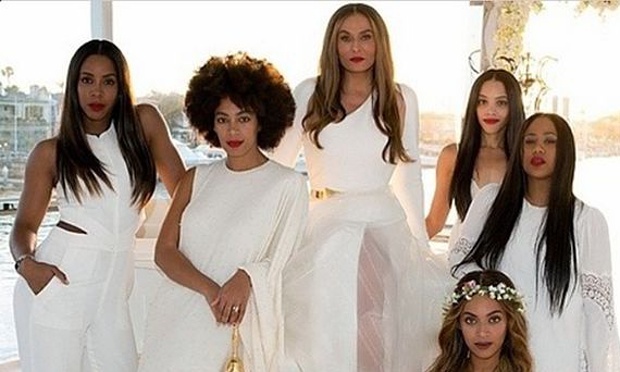
| Tina Knowles with friends and family at her recent wedding. Photograph: Instagram |
These questions are particularly relevant if, like me, the people around you getting married are in their 40s and over. And for some of them it’s not the first time.
“I didn’t want to wear white. I never wear white,” says 41-year-old photographers’ agent Harriet Margolies, who got hitched in a purple Amanda Wakeley evening dress that cost £400 in the sale and was customised by a friend. “I like a big, extravagant frock, but I wanted to feel like me. Not like I was in costume.”
Feeling relaxed and comfortable and not as if you’re in fancy dress is the modern way – as Kingham concurs: “The feedback we have had is that women want to feel special, to look and feel their best but, most importantly, they want to feel like themselves.”
Spending loads of money on a princess-for-a-day dress that’s going to end up in mothballs seems unnecessary. Particularly if it’s a second wedding: “Mature women marrying for the second time often look for something structured that isn’t too flouncy and over the top,” continues Kingham. “Dolce & Gabbana and Erdem are popular because they make beautiful lace dresses that work for a wedding and can be worn again.”
Style blogger Lisa Carnochan describes her experience: “The first time round I obsessed over a dress I’d seen in a magazine and hunted everywhere until I found it. The second time, I cared less and only went shopping because my sister wanted to go and bring her daughter along.” At the age of 57, Carnochan chose a one-shouldered white tulle teadress, subsequently altered to remove a couple of frilly layers: “I like to think wear and tear on a woman increases tulle’s style quotient. And I’m not usually a fan of asymmetry, but there was nothing about being 57 that would stop me one-shouldering.”
This contemporary approach is something retailers are considering. The ShopStyle website has an online boutique dedicated to alternative wedding dresses featuring designers such as Valentino, Emilia Wickstead and The Row, as well as high-street favourites such as Ghost’s Hollywood Cassidy style that can be dyed to order. Taking the anti-wedding approach is Julia Douglas, a former head of brand publications at M&S, with the soft launch of her new MyDayMyWay website. “The plan is to ditch the cliches that are so prevalent in this industry and to give the bride more choice. If someone calls up and wants a white biker jacket, I will source it for them.”
And men are moving things forward, too. Photographer Tom Parker plans to marry in June wearing a bright-green suit and trainers, while strategy director Patrick Lodge tied the knot with his husband dressed in a Paul Smith shirt and pair of old jeans. “We deliberately didn’t want any fanfare,” says Hodge, “I just wanted to buy stuff I’d wear again, which would remind me of a really happy time. My whole thing was that it didn’t have to be an orgy of commerce.”
Could this more-relaxed attitude be an age-related phenomenon for the older and wiser? With maturity comes an appreciation for the things that really matter and less of a tendency to play keeping up with the Joneses. “I think it’s definitely age,” adds Lodge. “I’m 44 and I know that I don’t need that much money to have a great time. It’s down to the ingredients: the right mix of people, the mood and where you are.”
Thursday, July 2, 2015
Wedding costs can quickly grow, but couples need not say ‘I do’ to paying an average of £7,500 on their big day
![]() |
| Wedding daze: couples should think creatively to cut spending on their big day. Photograph: Tetra Images/Alamy |
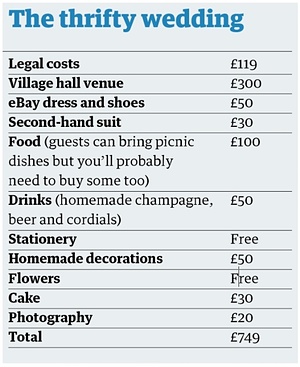
But celebrating with a bit of fanfare doesn’t have to break the bank. In fact, it is perfectly possible to tie the knot for less than a grand.
The basics
To be legally married, costs start at around £120. That covers fees for the notice of marriage (£35 for each partner) and a brief registry office service on a weekday. In Chester, for example, hiring a room in the city centre registry office that seats 50 guests costs £49, and that includes the marriage certificate (usually £3.50). The cost of this type of basic, legal service is about the same anywhere in the UK, including more expensive cities such as London.
If you want to get married in an approved venue (you cannot just do it in your local pub), you will need to pay for a registrar, which can easily run to £400 at weekends, and you will also have to fork out for the hire of a venue. If you want a religious service costs will vary again – a Church of England wedding, for example, will set you back £413.
The dress
Brides spend an average of £1,098 on their dress, according to the magazine You & Your Wedding, but there are an increasing number of cheaper options on the high street, where wedding dresses start from about £150. If you are willing to wear a secondhand frock, check out Oxfam’s online shop or one of its 11 bridal departments across the UK – grooms can have their pick of suits from just £20.
There are also specialist second-hand websites, charity shops and eBay – which is where newlywed Alex Fitton, a London-based chef, found her dress. She says: “It was a vintage dress in a shorter, informal style, and it cost £45. I bought plain shoes from Primark and made them sparkly with glue and glitter.”
Brides happy to wear “something borrowed” could use a friend’s dress or find an outfit for free on websites such as Freecycle or Freegle. Other ideas include making your own (see eHow.co.uk for ideas) or buying material and paying a local seamstress.
You don’t have to limit yourself to the wedding department of shops, either. This year there are plenty of white and ivory lace dresses in fashion, which may prove cheaper (fingers crossed, though, that one of your guests doesn’t turn up in the same dress).
The venue
Opting for a Sunday or off-peak winter wedding will help you avoid the high rates charged for summery Saturdays. “Even the very best venues have quieter times, so check when they are and negotiate costs if you take an off-peak date, or investigate local restaurants that have a private dining room you could use,” advises wedding planner Liz Taylor of the Taylor Lynn Corporation.
You can also cut costs by throwing a garden party if friends or family have a large enough space, having a picnic in the park or beside a river, or hiring a local pub with a garden. Last July, Jennifer Earle had her reception in a pub. “We played music on our iPods in the garden and borrowed garden games for free entertainment,” she says.
Local community centres are also a popular cost-saving option. Jo Dyer, who lives in Plymouth, had her reception in a village hall. “We booked it from Friday through to Sunday. This meant we had plenty of time to set it up and take the decorations down – and it cost £300,” she says.
Sites such as Halls for Hire, Hallshire.com and Hall Hire UK list everything from tiny local halls at £4 an hour to Grade II-listed castles. And don’t let the exterior put you off. Charlotte Ward, who is getting married in her old school grounds in Kent in August, has come up with a good solution. “I’ve arranged to have my wedding photos taken at a nearby museum with prettier grounds, in exchange for a donation,” she says.
Food and drink
Couples spend an average of £1,449 on wedding food and drink, according to research by VoucherCodes.co.uk. Ways to slice those costs include having your do later in the day (you then only have to feed your guests once rather than providing both lunch and evening food), buying food from a local restaurant rather than hiring caterers, and serving canapĂ©s as your starter and wedding cake as pudding.
If you can make a cake, or rope in a family member to make it, the ingredients can cost as little as £30 for 50 guests if you ditch the traditional fruit cake and whip up a sponge. This compares with an average of £660 for a professionally made cake. For example, the BBC’s Good Food website says its zingy lemon wedding cake costs less than a fiver to make – so if you slice it into eight, a £4.90 cake works out at 61p per guest.
For substantial savings, ask your guests to contribute food to your celebrations instead of buying gifts. Fitton says: “I suggested recipes and people made a portion big enough for about six people. There was plenty of food and guests took the leftovers home.”
There are also ways to save on wedding drinks. “We’ve bought Prosecco from Italy at £4.50 rather than £10 a bottle,” Ward says: “And we’re drinking out of jam jars instead of hiring glasses from the bar.”
Costs drop further if you make your own wine, cocktails, beer and cordials. Dyer served elderflower champagne for the toast. “It went down really well and cost only a few pounds,” she says.
Try this recipe from Andy Hamilton, author of Booze for Free.
Other costs
Forget the expensive gold-edged invitations and table decor – many couples send out emails and make their own decorations. “We printed our invites ourselves for about £34, but when people RSVPd we emailed the arrangements over,” Earle says. “Guests said this was handy as they had the details on their phone, and it was free.”
For photos, you can ask guests to upload their snaps to a dedicated website so you can take your pick and create an album online – or you can put disposable cameras on every table. Other ideas include asking a friend to act as photographer or paying a student from a local photography or art college.
There are social media sites such as Pinterest where you can find inspiration for creating homemade table decorations and stationery at a fraction of the cost of buying them ready-made.
Growing your own floral bouquet and buttonholes is also popular – seeds can be bought for a few pounds (or are even free at seed swaps) and you can grow posies in jam jars and then pick them fresh on the day.
Or you might prefer to go for dried flower arrangements. “We’ve bought lavender for the tables,” Ward says. “It works out at about £1.10 per table.”
Subscribe to:
Posts (Atom)