Thursday, July 16, 2015

Getting married over 40: fashion for the meringue-averse bride

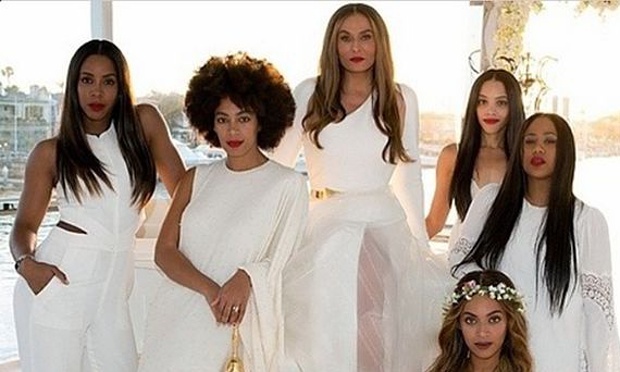
Tina Knowles with friends and family at her recent wedding. Photograph: Instagram
“Women are often wearing a cool pantsuit or a glamorous all-in-one as an alternative to the traditional wedding dress,” says Natalie Kingham, buying director at Matchesfashion.com. Recent bride Tina Knowles looked chic, but could have taken a leaf out of her daughter Solange’s book, whose recent wedding attire included a jumpsuit and matching cape. Today, the identikit wedding with the rigid dress code feels passé and unappealing. Who wants all the fuss, fascinators and a debt burden to rival that of Greece?

These questions are particularly relevant if, like me, the people around you getting married are in their 40s and over. And for some of them it’s not the first time.

“I didn’t want to wear white. I never wear white,” says 41-year-old photographers’ agent Harriet Margolies, who got hitched in a purple Amanda Wakeley evening dress that cost £400 in the sale and was customised by a friend. “I like a big, extravagant frock, but I wanted to feel like me. Not like I was in costume.”

Feeling relaxed and comfortable and not as if you’re in fancy dress is the modern way – as Kingham concurs: “The feedback we have had is that women want to feel special, to look and feel their best but, most importantly, they want to feel like themselves.”

Spending loads of money on a princess-for-a-day dress that’s going to end up in mothballs seems unnecessary. Particularly if it’s a second wedding: “Mature women marrying for the second time often look for something structured that isn’t too flouncy and over the top,” continues Kingham. “Dolce & Gabbana and Erdem are popular because they make beautiful lace dresses that work for a wedding and can be worn again.”

Style blogger Lisa Carnochan describes her experience: “The first time round I obsessed over a dress I’d seen in a magazine and hunted everywhere until I found it. The second time, I cared less and only went shopping because my sister wanted to go and bring her daughter along.” At the age of 57, Carnochan chose a one-shouldered white tulle teadress, subsequently altered to remove a couple of frilly layers: “I like to think wear and tear on a woman increases tulle’s style quotient. And I’m not usually a fan of asymmetry, but there was nothing about being 57 that would stop me one-shouldering.”

This contemporary approach is something retailers are considering. The ShopStyle website has an online boutique dedicated to alternative wedding dresses featuring designers such as Valentino, Emilia Wickstead and The Row, as well as high-street favourites such as Ghost’s Hollywood Cassidy style that can be dyed to order. Taking the anti-wedding approach is Julia Douglas, a former head of brand publications at M&S, with the soft launch of her new MyDayMyWay website. “The plan is to ditch the cliches that are so prevalent in this industry and to give the bride more choice. If someone calls up and wants a white biker jacket, I will source it for them.”

And men are moving things forward, too. Photographer Tom Parker plans to marry in June wearing a bright-green suit and trainers, while strategy director Patrick Lodge tied the knot with his husband dressed in a Paul Smith shirt and pair of old jeans. “We deliberately didn’t want any fanfare,” says Hodge, “I just wanted to buy stuff I’d wear again, which would remind me of a really happy time. My whole thing was that it didn’t have to be an orgy of commerce.”

Could this more-relaxed attitude be an age-related phenomenon for the older and wiser? With maturity comes an appreciation for the things that really matter and less of a tendency to play keeping up with the Joneses. “I think it’s definitely age,” adds Lodge. “I’m 44 and I know that I don’t need that much money to have a great time. It’s down to the ingredients: the right mix of people, the mood and where you are.”

Thursday, July 2, 2015

Wedding costs can quickly grow, but couples need not say ‘I do’ to paying an average of £7,500 on their big day

Wedding daze: couples should think creatively to cut spending on their big day. Photograph: Tetra Images/Alamy
The wedding season is in full swing, and while some couples are happy to throw cash around like confetti, others try to slash the cost of their big day. Those tying the knot can expect to pay an average of £7,500, according to Nationwide building society (that’s for couples of all ages, which includes the lower amounts older couples tend to spend), or more than £24,000 if you’re a reader of Brides Magazine.

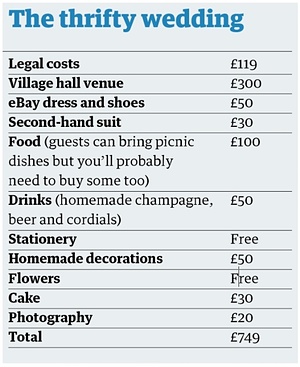
But celebrating with a bit of fanfare doesn’t have to break the bank. In fact, it is perfectly possible to tie the knot for less than a grand.

The basics

To be legally married, costs start at around £120. That covers fees for the notice of marriage (£35 for each partner) and a brief registry office service on a weekday. In Chester, for example, hiring a room in the city centre registry office that seats 50 guests costs £49, and that includes the marriage certificate (usually £3.50). The cost of this type of basic, legal service is about the same anywhere in the UK, including more expensive cities such as London.

If you want to get married in an approved venue (you cannot just do it in your local pub), you will need to pay for a registrar, which can easily run to £400 at weekends, and you will also have to fork out for the hire of a venue. If you want a religious service costs will vary again – a Church of England wedding, for example, will set you back £413.

The dress


Brides spend an average of £1,098 on their dress, according to the magazine You & Your Wedding, but there are an increasing number of cheaper options on the high street, where wedding dresses start from about £150. If you are willing to wear a secondhand frock, check out Oxfam’s online shop or one of its 11 bridal departments across the UK – grooms can have their pick of suits from just £20.

There are also specialist second-hand websites, charity shops and eBay – which is where newlywed Alex Fitton, a London-based chef, found her dress. She says: “It was a vintage dress in a shorter, informal style, and it cost £45. I bought plain shoes from Primark and made them sparkly with glue and glitter.”

Brides happy to wear “something borrowed” could use a friend’s dress or find an outfit for free on websites such as Freecycle or Freegle. Other ideas include making your own (see eHow.co.uk for ideas) or buying material and paying a local seamstress.

You don’t have to limit yourself to the wedding department of shops, either. This year there are plenty of white and ivory lace dresses in fashion, which may prove cheaper (fingers crossed, though, that one of your guests doesn’t turn up in the same dress).

The venue

Opting for a Sunday or off-peak winter wedding will help you avoid the high rates charged for summery Saturdays. “Even the very best venues have quieter times, so check when they are and negotiate costs if you take an off-peak date, or investigate local restaurants that have a private dining room you could use,” advises wedding planner Liz Taylor of the Taylor Lynn Corporation.

You can also cut costs by throwing a garden party if friends or family have a large enough space, having a picnic in the park or beside a river, or hiring a local pub with a garden. Last July, Jennifer Earle had her reception in a pub. “We played music on our iPods in the garden and borrowed garden games for free entertainment,” she says.

Local community centres are also a popular cost-saving option. Jo Dyer, who lives in Plymouth, had her reception in a village hall. “We booked it from Friday through to Sunday. This meant we had plenty of time to set it up and take the decorations down – and it cost £300,” she says.

Sites such as Halls for Hire, Hallshire.com and Hall Hire UK list everything from tiny local halls at £4 an hour to Grade II-listed castles. And don’t let the exterior put you off. Charlotte Ward, who is getting married in her old school grounds in Kent in August, has come up with a good solution. “I’ve arranged to have my wedding photos taken at a nearby museum with prettier grounds, in exchange for a donation,” she says.

Food and drink

Couples spend an average of £1,449 on wedding food and drink, according to research by VoucherCodes.co.uk. Ways to slice those costs include having your do later in the day (you then only have to feed your guests once rather than providing both lunch and evening food), buying food from a local restaurant rather than hiring caterers, and serving canapés as your starter and wedding cake as pudding.

If you can make a cake, or rope in a family member to make it, the ingredients can cost as little as £30 for 50 guests if you ditch the traditional fruit cake and whip up a sponge. This compares with an average of £660 for a professionally made cake. For example, the BBC’s Good Food website says its zingy lemon wedding cake costs less than a fiver to make – so if you slice it into eight, a £4.90 cake works out at 61p per guest.

For substantial savings, ask your guests to contribute food to your celebrations instead of buying gifts. Fitton says: “I suggested recipes and people made a portion big enough for about six people. There was plenty of food and guests took the leftovers home.”

There are also ways to save on wedding drinks. “We’ve bought Prosecco from Italy at £4.50 rather than £10 a bottle,” Ward says: “And we’re drinking out of jam jars instead of hiring glasses from the bar.”

Costs drop further if you make your own wine, cocktails, beer and cordials. Dyer served elderflower champagne for the toast. “It went down really well and cost only a few pounds,” she says.

Try this recipe from Andy Hamilton, author of Booze for Free.

Other costs

Forget the expensive gold-edged invitations and table decor – many couples send out emails and make their own decorations. “We printed our invites ourselves for about £34, but when people RSVPd we emailed the arrangements over,” Earle says. “Guests said this was handy as they had the details on their phone, and it was free.”

For photos, you can ask guests to upload their snaps to a dedicated website so you can take your pick and create an album online – or you can put disposable cameras on every table. Other ideas include asking a friend to act as photographer or paying a student from a local photography or art college.

There are social media sites such as Pinterest where you can find inspiration for creating homemade table decorations and stationery at a fraction of the cost of buying them ready-made.

Growing your own floral bouquet and buttonholes is also popular – seeds can be bought for a few pounds (or are even free at seed swaps) and you can grow posies in jam jars and then pick them fresh on the day.

Or you might prefer to go for dried flower arrangements. “We’ve bought lavender for the tables,” Ward says. “It works out at about £1.10 per table.”
Monday, June 15, 2015

What to wear to a summer wedding

There’s nothing better than a wedding. Dressing up nice and drinking in the afternoon with a roomful of people who are giddily happy. A good reception feels like it’s drenched in endorphins – almost like a birth but better, because there’s lots of champagne and no placenta. But weddings are not a pleasure that come cheap. Much is made of the cost of the average British wedding – approximately £20,000 – but that doesn’t include the small fortune that guests have grudgingly spent on gifts, travel, hotels and clothes.
Well, I can help a bit with a well-priced outfit. Most wedding invitations are vague on dress code, so use the happy event as an excuse to buy yourself a summer dress. The most on-trend frock for this year would be in white lace or broderie anglaise. If you’re feeling bullish, give one a whirl, but brides can be such selfish cows about that sort of thing. I’ve included one as the catwalk picture in case any brides-to-be need inspiration. The rest of the clothes on this page are all intentionally reasonably priced.
Wedding fashion
If you want something pretty go for a pink or a floral. Both were big trends and if you choose the right one, you can wear it for years to come. Finery London is a great place to look for unfeasibly cheap dresses. It was co-founded by fashion directors from Topshop and Asos, and the designs and prices are excellent. I like this pink dress. Ballerina was a catwalk trend that will never take off as tulle skirts look stupid unless you’re three years old. But ballerina pink is flattering with a tan, so it’s a great colour for summer.
Other on-trend styles include maxi dresses, jumpsuits and anything asymmetric. This jumpsuit is from A Day in the Life – it’s another new label and its first capsule collection is very pretty. The prints are fantastic. You should have a look.
Weddings do demand a few practical considerations. If it’s a good one, it will go on long into the night so you’ll need something warm to put on, particularly if you’re in a marquee. Don’t worry about whether a cardy will ruin your outfit – by the time you put it on, everyone should be past caring anyway. Or why not buy something like this lovely kimono coat from Marks and Spencer. Kimonos and Japanese style in general are big for summer, so this will get plenty of use throughout the coming months.
Also, make sure your handbag has a strap. You need a bag if you’re out for the day, and there’s nothing more annoying than having a clutch in one hand, a drink in the other, and no way of eating the canapés as they whizz past.
I’m sure you know your own feet and their limitations for standing in heels, so the only advice I’ll give is to look at the shoes in & Other Stories. Another shop that has excellent and unusual wares that are surprisingly well priced.
This lot should see you through the big day – have a brilliant time.

Monday, April 13, 2015

Would you wear a wedding dress made from fungus?

Woman choosing wedding dress 
Would you wear clothing grown from a mixture of yeast, bacteria and a sugary green tea solution? How about from a combination of plant matter and microscopic mushrooms? These odd materials may sound like something out of the Jetsons’ wardrobe, but they could have an influence on how fashion is manufactured.
“I think the ability for us to grow our own clothing could have great positive potential,” says Erin Smith, artist in residence at Microsoft Research who brewed her own wedding dress. “Growing clothing from scratch could both eliminate carbon emissions caused by transportation and allow for a garment that can be grown to your precise dimensions and specifications.”
Smith produced her dress using a combination of tree mulch and mycelium – a type of naturally white fungus. The mycelium was bred in a tub of agricultural waste requiring very little added energy. Once the dress had been worn, it could be composted in the garden. She made the decision to grow her own dress because she didn’t want her wedding to be dictated by tradition and to have to wear something that would just sit in her wardrobe after the event.
“The concept behind a grown wedding dress was to take a one-time-use object and rethink its construction in order to have an appropriate material lifespan. The average cost of a wedding dress in the US is roughly $1,200 (£792) and can contain nearly 12 yards (11m) of fabric,” explains Smith, adding that making the fashion chain circular not only brings us closer to the environment but also reflects how needless our consumption habits are: “The wedding dress is a perfect example of a one-time-use, energy intensive and entirely non-sustainable model that is representative of so many of the choices that we make daily.”
Growing a garment from mycelium isn’t a novel concept. The most notable figure in the field of biomaterials is Suzanne Lee, founder of BioCouture, a design consultancy that works with brands to apply similar technology to sportswear and luxury fashion products. Lee has been experimenting with the idea of fermenting clothes for over a decade and has grown a type of vegetable leather from green tea, sugar, bacteria and yeast.
Fermented material
Fermented material. Photograph: BioCouture
Back in 2004, a team at the University of Western Australia showcased a jacket from living tissue – mouse and human cells to be specific. And, a couple of years ago, Bioalloy, a research project based in the labs at the same university, produced a garment from alcohol using fibrous cellulose created by introducing bacteria into red wine.
Scientists and designers are increasingly looking at ways to blur the boundaries between biology and fashion. The technology is clearly there, but what about the demand? There is an acknowledgment that biomaterials are unlikely to replace cotton and leather, and that fast fashion will keep relying on oil-based polymers like polyester.
Lee has previously argued that biomaterials such as microbial cellulose would simply be “a smart and sustainable addition to our increasingly precious natural resources”. They do have environmental advantages, particularly in terms of water. For example, the team behind Scoby Tec’s biker jacket brewed from kombucha (a fermented drink made with tea, sugar, bacteria and yeast) claims that only 60 litres of water are required for one square metre of its leather. In comparison, it takes 20,000 litres to produce a single T-shirt and pair of jeans, according to WWF.
ScobyTec jacket
ScobyTec’s biker jacket. Photograph: Marcel Wiessler
Despite the clear advantages, there are challenges that need addressing before bacteria-grown clothes can reach the racks. First, there’s an issue of scalability. The current processes used are arduous and time-consuming. It took Smith about a week to grow her dress. And, if you followed Lee’s DIY recipe, it would take two to four weeks to grow your material. The question for the fashion industry therefore is how it can deliver such garments on a commercial scale without cutting corners to save money. A possible scenario highlighted by Lee is one where industrial vats of sugar from streams of food waste provide the breeding ground for bacteria.
Second, there are doubts about whether people would happily wear something that has been fashioned from waste. A straw poll carried out suggests that some are uncomfortable with the idea. One respondent said it would be like putting dirty clothes back on after a bath. Others said that the thought of it made their skin crawl. Another said that we already wear silk (in his own words: “protein from a worm’s a***”), so we shouldn’t have any qualms about pulling bacteria-grown clothes off the racks.
Given the technology’s environmental benefits, including the fact that the materials can be biodegraded after use, would applying it to manufacture supposedly unnecessary high-end items be counterproductive if it could be scaled up and people could overcome their aversion? Smith suggests not, because people are always going to buy and throw away clothes regardless. Growing them is simply an eco-friendly alternative.
“It’s essential that consumers become more aware of the continued lifespan of their things once they’ve been thrown away,” she says. “Any object made from materials that will outlive its intended use is a part of our global waste problem.”
The sustainable fashion hub is funded by H&M. All content is editorially independent except for pieces labelled ‘brought to you by’. Find out more here.

Tuesday, March 10, 2015

UK legal notice of intention to wed rises from 15 to 28 days

The Home Office has new powers to delay nuptials for a further 70 days while inquiries take place.
Couples must give almost twice the official notice of their intention to wed from Monday as part of a crackdown on bogus marriages.
A UK-wide extension from 15 to 28 days was approved by parliament last year in order to allow more time for investigation.
Ministers have made clear they expect registrars to report suspicions to the Home Office, which has new powers to delay nuptials for a further 70 days while inquiries take place.
The changes have already prompted an 80% increase in reports of suspected sham cases – from 1,099 between July and December 2013 to more than 2,000 in the same period last year.
Immigration and security minister James Brokenshire said: “As of today, marriage can no longer be seen as a ‘fast-track option’ for those seeking to abuse marriage to cheat their way into the UK.”